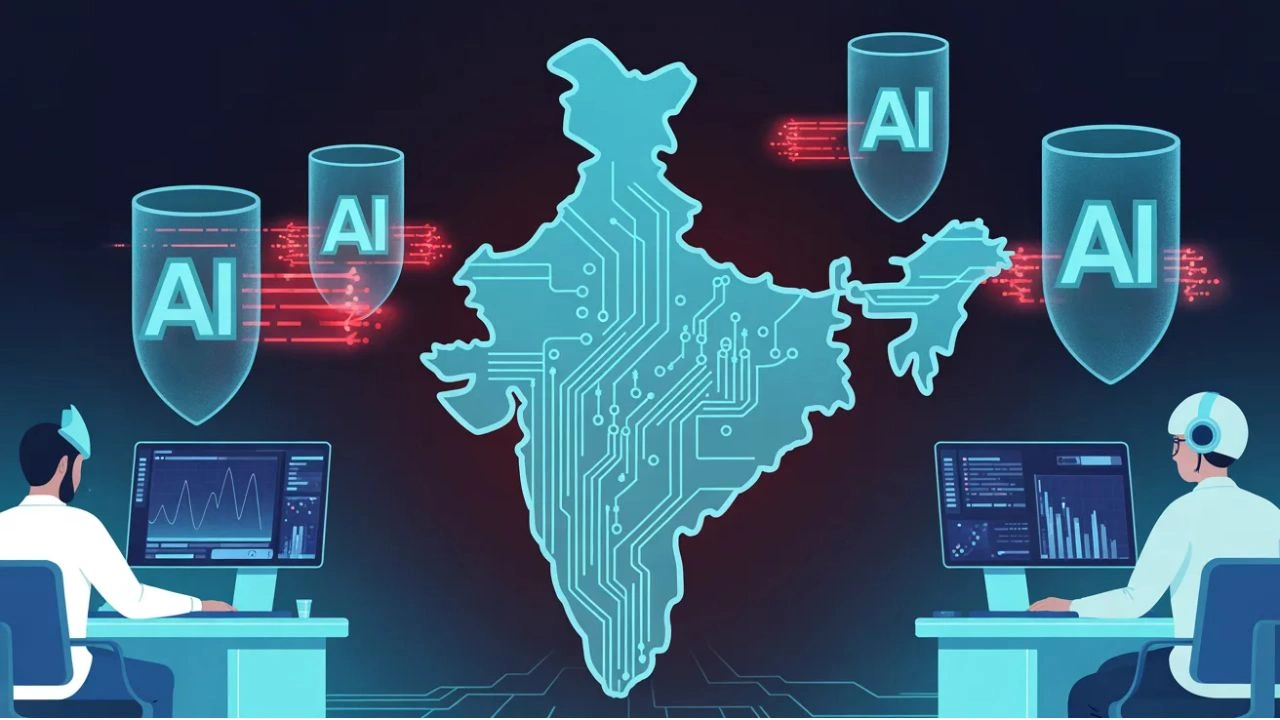
India weekly cyber attacks AI cybersecurity: India’s digital transformation is accelerating at an extraordinary pace, but alongside innovation comes a rapidly intensifying cyber threat landscape. Recent cybersecurity findings reveal that organisations across the country are now experiencing more than 3,100 cyber-attacks every week, a statistic that underscores both the scale of digital adoption and the growing sophistication of modern cybercrime.
This sharp rise in attacks is not merely a numerical increase. Experts warn that artificial intelligence is fundamentally reshaping how cyber-attacks are designed, launched, and executed, forcing governments, businesses, and institutions to rethink traditional defence strategies. What was once a battle of human hackers versus security teams has evolved into a complex technological contest driven by automation, data, and intelligent threat modelling.
A Rapidly Expanding Threat Landscape in a Digitally Growing Nation
India stands among the world’s fastest-digitising economies. From financial technology and e-governance to online education and cloud-based enterprise systems, digital infrastructure now supports nearly every sector of national growth. While this transformation delivers efficiency and accessibility, it also expands the attack surface available to cybercriminals.
Security analysts estimate that Indian organisations face thousands of attempted breaches each week, reflecting a steady upward trend compared with previous years. Even a modest percentage increase represents a massive escalation in real-world exposure because of the sheer size of India’s connected ecosystem.
This environment creates a paradox:
- Greater connectivity fuels economic progress, innovation, and global competitiveness.
- The same connectivity multiplies vulnerability, offering attackers more entry points than ever before.
As a result, cybersecurity is no longer a technical afterthought—it has become a national resilience priority.
Read Also: Realme Neo 8: A True Performance Flagship Built for Power Users
Artificial Intelligence Changes the Rules of Cyber Warfare
Perhaps the most significant shift in the modern threat environment is the integration of artificial intelligence into cyber-attack strategies. Earlier generations of cybercrime relied heavily on manual coding, phishing emails written by individuals, and slow reconnaissance. Today, AI enables attackers to automate nearly every stage of intrusion.
Key transformations driven by AI include:
1. Speed and Scale of Attacks
AI systems can scan networks, identify weaknesses, and deploy exploits within seconds, allowing attackers to target thousands of systems simultaneously.
2. Personalised Social Engineering
Machine-learning models analyse publicly available data to craft highly convincing phishing messages, dramatically increasing the likelihood of user deception.
3. Adaptive Malware Behaviour
AI-enhanced malware can change its signature in real time, helping it evade detection by traditional antivirus and rule-based security systems.
4. Autonomous Attack Campaigns
Some emerging threat models suggest the rise of semi-autonomous cyber operations that require minimal human supervision once deployed.
Together, these developments signal a profound change:
Cybercrime is evolving from manual intrusion to intelligent automation.
Sectors Under Intense Cyber Pressure
Although cyber-attacks affect nearly every industry, data indicates that certain sectors are experiencing disproportionately high targeting levels.
Education Systems
Educational institutions rank among the most attacked environments. Their combination of large user bases, valuable personal data, and often limited cybersecurity budgets makes them attractive targets. Weekly attack volumes in this sector far exceed national averages.
Government Infrastructure
Public-sector systems hold sensitive citizen information and critical administrative functions. Attacks on government networks are not only financially motivated but may also involve espionage, disruption, or geopolitical signalling.
Business and Professional Services
Corporate environments—especially those managing financial transactions or intellectual property—face continuous intrusion attempts, including ransomware, credential theft, and supply-chain compromise.
The breadth of targeting confirms a crucial reality:
No industry can assume immunity in the AI-driven cyber era.
The Evolving Threat of Ransomware in the AI Age
Ransomware remains one of the most disruptive forms of cybercrime, and AI is amplifying its impact. Instead of a few large criminal syndicates, the ecosystem now includes numerous smaller, specialised groups capable of launching sophisticated extortion campaigns.
Modern ransomware trends include:
- Precision targeting of high-value victims using data analytics.
- Double-extortion tactics, where attackers both encrypt data and threaten public leaks.
- Lower technical barriers, allowing less-skilled actors to deploy powerful ransomware kits.
These developments mean ransomware is no longer an occasional crisis—it is a persistent operational risk for organisations of every size.
Why Traditional Cybersecurity Models Are No Longer Enough
For years, many organisations relied on perimeter-based security: firewalls, antivirus software, and reactive incident response. However, AI-driven threats move faster than reactive defence mechanisms.
Security researchers now emphasise a shift toward:
Prevention-First Architecture
Stopping attacks before execution, rather than responding after breach detection.
Zero-Trust Security Models
Assuming no user or device is automatically trustworthy, even within internal networks.
AI-Powered Defence Systems
Using machine learning to detect anomalies, predict threats, and automate responses at machine speed.
Continuous Monitoring and Resilience
Designing systems that remain operational even during active cyber incidents.
This transformation marks a philosophical change:
Cybersecurity is transitioning from defence to resilience engineering.
The Economic and Social Stakes of Cybersecurity in India
Cyber-attacks are not merely technical disruptions—they carry serious economic and societal consequences.
Financial Impact
Data breaches, ransomware payments, operational downtime, and regulatory penalties can cost organisations millions of dollars per incident.
Trust and Reputation
Repeated cyber incidents erode public confidence in digital services, slowing adoption of online governance and fintech solutions.
National Security Concerns
Attacks on infrastructure, utilities, or government systems raise strategic security implications, extending beyond corporate risk into national stability.
Given India’s ambitions to lead in digital innovation, cyber resilience is inseparable from economic growth.
Government and Industry Response: Building a Cyber-Resilient Future
Recognising the scale of the challenge, policymakers and industry leaders are intensifying cybersecurity initiatives.
Strengthening Regulatory Frameworks
New compliance standards and reporting requirements aim to improve transparency and preparedness across sectors.
Expanding Cybersecurity Workforce
India is investing in training programs, academic partnerships, and skill development to address the global shortage of security professionals.
Encouraging Public-Private Collaboration
Information sharing between government agencies and private firms enhances collective threat intelligence and rapid response.
Promoting Indigenous Security Innovation
Support for domestic cybersecurity startups helps build locally tailored defence technologies suited to India’s unique digital ecosystem.
These measures indicate a growing consensus:
Cybersecurity must evolve alongside digital transformation—not lag behind it.
The Global Context: India Within a Worldwide Cyber Conflict
India’s experience mirrors a broader international trend. Across continents, organisations report rising attack frequency, AI-driven threat evolution, and expanding ransomware ecosystems.
However, India’s scale, population, and rapid digitisation make the stakes particularly high. Success in securing its digital infrastructure could position the country as a global model for cyber resilience in emerging economies.
Read Also: Honor 500 Pro Review: Battery, Camera and Snapdragon 8 Elite Power
Looking Ahead: The Future of AI, Cybercrime, and Defence
The coming decade will likely define the balance between AI-enabled attackers and AI-empowered defenders.
Possible future scenarios include:
- Fully automated cyber battlefields where machines attack and defend in real time.
- Regulatory frameworks governing offensive AI use in cyberspace.
- Greater integration of cybersecurity into everyday technology design.
- Public awareness becoming a frontline defence layer against social engineering.
One certainty remains:
Cybersecurity will be one of the defining technological challenges of the 21st century.
Conclusion: A Critical Turning Point for India’s Digital Security
India’s exposure to over 3,100 weekly cyber-attacks signals more than a statistical milestone—it represents a structural shift in the nature of digital risk. Artificial intelligence is accelerating both innovation and vulnerability, creating a high-stakes race between attackers and defenders.
The path forward demands strategic investment, technological evolution, workforce development, and national coordination. If successfully navigated, India can transform this challenge into an opportunity—building one of the world’s most resilient digital ecosystems.
In an era where data is power and connectivity defines progress, cybersecurity is no longer optional. It is foundational to the future of the nation.
1 thought on “India Confronts a New Cybersecurity Reality as AI-Driven Attacks Surge Beyond 3,100 Weekly”